What this block is about
Mooring is securing the boat to a quay or buoy; anchoring is fixing it to the bottom with the anchor. It is not an eliminating block, but it is one of the most practical: here are the elements, the knots that come up in the exam and a well-executed anchoring manoeuvre.
Mooring elements
- Bollard (noray): the fixed piece on the quay to which the lines are made fast.
- Bitts (bitas) and cleats (cornamusas): pieces on board for making lines fast.
- Moorings (muertos): a permanent anchorage on the bottom, marked with a buoy, to make fast to.
- Fenders (defensas): they protect the side from chafing against the quay or another boat.
- Boat hook (bichero): a pole with a hook to reach lines or to come alongside.
Vocabulary of a line: the end (chicote) is each extremity; the standing part (firme), the fixed part; the bight (seno), the curve between two points; the eye (gaza), a loop made in the line.
The four exam knots
- Reef knot (nudo llano): joins two ends of the same line (of the same thickness).
- Bowline (as de guía): forms a fixed eye that does not slip; the most useful knot on board.
- Clove hitch (ballestrinque): makes fast to a spar or ring, and is very easy to undo.
- Fisherman's bend (vuelta de rezón): used to secure a line to an anchor or grapnel.
The anchor and its parts
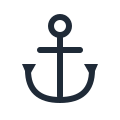
The anchor holds to the bottom so the boat does not drift. Its main parts are the ring (arganeo) (where the line is attached), the shank (caña) (the body), the arms (brazos), the flukes (uñas) (which bite into the bottom) and the stock (cepo). The chain is joined to the ring by the bending shackle (grillete de entalingadura) (this operation is called bending on, *entalingar*).
Anchoring well
- Choose the holding ground: a bottom that holds well (sand or mud) rather than rock or weed, and sheltered from the wind and the sea.
- The manoeuvre (riding to a single anchor): approach with the bow to the wind or the current, stop the way, let go the anchor and veer the cable little by little while the boat falls back; check that the anchor holds.
- The length: the anchor cable carried on board should not be less than about five times the boat's length. What you veer when anchoring depends on the depth (sounding) and the weather: as a reference, three to four times the sounding in good weather, and more in bad weather.
- Swinging circle (círculo de borneo): the circle the boat describes turning around the anchor; before anchoring, check that within that radius there are no obstacles or other boats.
- Watch in case it drags: a boat drags (garrea) when the anchor slips along the bottom and stops holding it, and it starts to drift. To detect it, take bearings to land and use the depth alarm.
- The trip line (orinque): a line joining the anchor to a small buoy on the surface (a dan buoy) to locate it and help free it if it fouls.
- Weighing (levar): recovering the anchor on board (heaving in the chain with the windlass and its gypsy, the drum that hauls the chain, which runs out through the hawsepipe at the bow).
How to study it
- Link each knot to its use: reef knot = join, bowline = fixed eye, clove hitch = to a ring/spar, fisherman's bend = to an anchor.
- For anchoring, keep three ideas: bow to the wind, veer 3-4 times the sounding (more in bad weather) and watch the swinging and the dragging.
- Memorise the parts of the anchor by looking at the drawing: ring, shank, arms, flukes and stock.