What is buoyage and why is it worth mastering?
Buoyage is the set of marks —buoys and beacons— that mark the navigable channels, the dangers and the areas of interest for those at sea. In the PER exam, buoyage (UT5) is an eliminating block: you need a minimum number of correct answers in it to pass, however well the rest goes. That is why it is one of the blocks where it pays most to leave nothing to chance.
The good news is that the whole system follows a logic: once you understand how a mark «speaks» —by its colour, its shape, its topmark and its light— you can identify any of them without memorising everything at once. This guide goes through the six types of mark in the IALA system as they apply in Spain.
The IALA system and the two regions
The IALA Maritime Buoyage System (MBS) is the international standard that unifies the characteristics of buoyage. There are two regions, A and B, which differ only in the lateral marks; the rest of the marks are identical worldwide. Spain belongs to Region A (along with the rest of Europe, Africa, Oceania and most of Asia). In Region B (the Americas, Japan, Korea and the Philippines) the lateral colours are reversed.
Every mark is identified by:
- By day: its colour, its shape (cylindrical, conical, spherical, pillar or spar) and its topmark (the figure on top).
- By night: the colour of its light (white, red, green or yellow) and its rhythm (flashes, quick flashes, occultations or isophase).
A key concept is the conventional direction of buoyage: the direction of the navigator coming from seaward and approaching a port, river or estuary. It is what defines which side is port and which is starboard on the lateral marks.
1. Lateral marks (Region A)
They mark the lateral limits of a channel. Coming from seaward towards the port, in Region A:
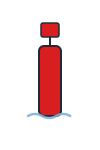
Port (left): RED, cylindrical (can-shaped). Topmark: a red cylinder. If it carries a light, it is red.
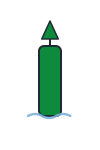
Starboard (right): GREEN, conical with the point upwards. Topmark: a green cone with the point upwards. If it carries a light, it is green.
Practical rule: when entering port you leave red to port and green to starboard; when leaving, the other way round. (In Region B the colours would be reversed.) Where a channel divides, a lateral mark with a horizontal band of the other colour marks the preferred channel; its light, if any, is composite group flashing (2+1).
2. Cardinal marks
They show where the navigable water is in relation to the mark: to the north, south, east or west of it. They are associated with the points of the compass and are common to both regions.
- Colour: a combination of black and yellow.
- Topmark: always two black cones, one above the other; their orientation defines the type.
The rule that solves it all by day is: «black goes where the cones point».
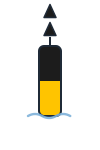
North: cones pointing up → black on top, yellow below. Safe water to the north.
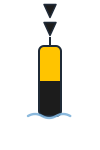
South: cones pointing down → yellow on top, black below. Safe water to the south.
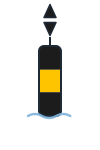
East: cones opposed base to base (pointing outwards) → black-yellow-black. Safe water to the east.
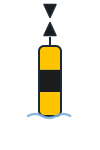
West: cones opposed point to point (cup shape) → yellow-black-yellow. Safe water to the west.
By night, the light is white and quick-flashing, and the number of flashes is remembered with a clock face:
- North (12): continuous quick flashing, without a pause.
- East (3): groups of 3 flashes.
- South (6): groups of 6 flashes plus a long flash (the long flash avoids confusing it with the west mark).
- West (9): groups of 9 flashes.
3. Isolated danger mark
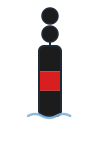
It is placed on top of a danger of limited extent that has navigable water all around it.
- Colour: black with one or more horizontal red bands.
- Topmark: two black spheres, one above the other.
- Light (if any): white, in groups of 2 flashes — Fl(2).
4. Safe water mark
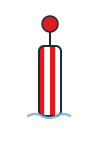
It shows that the water is navigable all around it: channel axes and centres, landfall or approach to a port.
- Colour: vertical red and white stripes.
- Topmark: a single red sphere.
- Light (if any): white — isophase, occulting, one long flash every 10 s, or the Morse letter «A» (·–).
5. Special marks

They mark a special area or configuration recorded on the chart or in the pilot book: exercise areas, cables and pipelines, dumping grounds, recreation areas, measuring devices (ODAS), etc.
- Colour: yellow.
- Topmark (if any): a yellow cross (X-shaped).
- Light (if any): yellow, with a rhythm that is not confused with the white-light marks.
6. New danger and wreck marks
A «new danger» is a recently discovered obstacle that does not yet appear on the charts (a wreck, for example). It can be marked with lateral, cardinal or isolated danger marks, or with the emergency wreck marking buoy, added to the IALA system in 2006. This mark has alternating vertical blue and yellow stripes (between 4 and 8), a yellow cross topmark, and an alternating blue and yellow light. It usually also carries a Racon with the Morse letter «D» (for Danger). If the risk is very high, one of the marks is duplicated to draw attention.
How to pass the buoyage block
- Learn the logic first, not the list: colour + shape + topmark + light tell the whole story.
- For the cardinals, fix two rules: «black goes where the cones point» (by day) and the clock of flashes (by night). With that you solve all four.
- Remember that in Spain you are in Region A: red to port, green to starboard when entering port.
As it is an eliminating block (min. 3/5), practise until you have it solid. In our mock exam, the buoyage questions are flagged as an eliminating block and the result warns you if you do not reach the minimum.
Practise this topic