Exam questions: Buoyage (balizamiento)
24 questions with the answer, the explanation and the official rule behind it. Part of the PER and PNB syllabus.
Buoyage (balizamiento) is an eliminating block: you must get at least 3 questions right in this block to pass, even if your overall score would be enough.
-
1

En la región de balizamiento A (España), ¿qué color tiene la marca lateral de babor de un canal?
- Rojo Correct answer
- Verde
- Amarillo
- Negro
Why?
In Region A, lateral marks are red to port and green to starboard, by day and night. Entering harbour, the red (port) marks lie to your left and the green (starboard) to your right, matching your own sidelights. In Region B (Americas, Japan, Korea, Philippines) the colours are reversed.
Source IALA, Recomendación R1001 Ed. 2.0 (junio 2022), secc. 1.1 y 2.1.3 · Temario: RD 875/2014, anexo II, UT5 «Balizamiento» (BOE-A-2014-10344)
-
2
Una marca lateral de babor (Región A) puede tener forma cilíndrica y, como marca de tope:
- Un cilindro rojo Correct answer
- Un cono verde con el vértice hacia arriba
- Dos esferas negras
- Un aspa amarilla
Why?
Port lateral mark in Region A: red and, where the buoy has a distinctive shape, cylindrical (can) shaped; it may also be a pillar or a spar. Its topmark is a single red cylinder and, if lit, the light is red. The starboard mark is the mirror image: green, conical, with a single green cone point upward and a green light. So the red cylinder in the question can only belong to a port mark.
Source IALA, Recomendación R1001 Ed. 2.0 (junio 2022), secc. 2.1.3 · Temario: RD 875/2014, anexo II, UT5 «Balizamiento» (BOE-A-2014-10344)
-
3

La marca lateral de estribor en la Región A es de color verde y su forma característica es:
- Cónica Correct answer
- Cilíndrica
- Esférica
- De aspa
Why?
The starboard mark (Region A) is green and conical, with a green cone topmark (apex up) and a green light. The port mark is red and cylindrical. Tip: starboard = green and cone; port = red and can.
Source IALA, Recomendación R1001 Ed. 2.0 (junio 2022), secc. 2.1.3 · Temario: RD 875/2014, anexo II, UT5 «Balizamiento» (BOE-A-2014-10344)
-
4
Al entrar a puerto en la Región A siguiendo el sentido convencional de balizamiento, las marcas verdes de estribor las dejaremos a:
- Nuestra derecha (estribor) Correct answer
- Nuestra izquierda (babor)
- Ambas bandas indistintamente
- La popa
Why?
Entering harbour, the green (starboard) marks are on your right and the red (port) ones on your left, matching your sidelights. Leaving, it is reversed. The conventional direction is that of a vessel approaching a harbour, river or estuary from seaward.
Source IALA, Recomendación R1001 Ed. 2.0 (junio 2022), secc. 2.1.1.1 y 2.1.3 · Temario: RD 875/2014, anexo II, UT5 «Balizamiento» (BOE-A-2014-10344)
-
5
Respecto a las marcas laterales, ¿en qué se diferencian las regiones A y B de la IALA?
- En la Región B los colores se invierten: rojo a estribor y verde a babor Correct answer
- En la Región B no existen marcas laterales
- En la Región B las marcas laterales son siempre amarillas
- No existe ninguna diferencia entre ambas regiones
Why?
Only lateral marks differ between regions: in Region A (Spain) red to port and green to starboard; in Region B (Americas, Japan, Korea, Philippines) the reverse, red to starboard and green to port. The other five mark types (cardinal, isolated danger, safe water, special and new dangers) are common to both regions.
Source IALA, Recomendación R1001 Ed. 2.0 (junio 2022), secc. 1.1 y 2.1.3 · Temario: RD 875/2014, anexo II, UT5 «Balizamiento» (BOE-A-2014-10344)
-
6
En la bifurcación de un canal (Región A), una marca que indica que el canal principal queda a estribor es:
- Roja con una banda ancha horizontal verde Correct answer
- Verde con una banda ancha horizontal roja
- Amarilla con una banda negra
- Negra con dos bandas rojas
Why?
Preferred-channel-to-starboard mark: red body with one broad horizontal green band (a modified port mark), red cylinder topmark and a red light with rhythm Gp Fl(2+1). If the preferred channel is to port, it is green with a red band, green cone, and a green Gp Fl(2+1) light.
Source IALA, Recomendación R1001 Ed. 2.0 (junio 2022), secc. 2.1.5 · Temario: RD 875/2014, anexo II, UT5 «Balizamiento» (BOE-A-2014-10344)
-
7

Una boya con franjas verticales rojas y blancas, coronada por una esfera roja, indica:
- Aguas navegables a su alrededor (p. ej. centro de canal o recalada) Correct answer
- Un peligro aislado
- El límite de babor de un canal
- Una zona militar
Why?
It is a safe-water mark: red and white vertical stripes, topmark a single red ball. It indicates navigable water all around (mid-channel, landfall, centre of the fairway). It marks no danger: you may pass on either side.
Source IALA, Recomendación R1001 Ed. 2.0 (junio 2022), secc. 2.4.2.2 · Temario: RD 875/2014, anexo II, UT5 «Balizamiento» (BOE-A-2014-10344)
-
8
La luz de una marca de aguas navegables es de color blanco y su ritmo puede ser:
- Isofase, de ocultaciones, un destello largo cada 10 s o letra «A» Morse Correct answer
- Roja de grupos de dos destellos
- Amarilla de centelleos
- Verde fija
Why?
The safe-water mark carries a white light with an isophase, occulting, one-long-flash-every-10-s, or Morse 'A' (· —) rhythm. The white light and these rhythms set it apart from the other marks.
Source IALA, Recomendación R1001 Ed. 2.0 (junio 2022), secc. 2.4.2.2 · Temario: RD 875/2014, anexo II, UT5 «Balizamiento» (BOE-A-2014-10344)
-
9

Una marca negra con una o más franjas horizontales rojas y coronada por dos esferas negras superpuestas es una marca de:
- Peligro aislado Correct answer
- Aguas navegables
- Cardinal sur
- Canal principal a babor
Why?
This is the isolated-danger mark: black body with one or more red horizontal bands and a topmark of two black balls. It is moored on or over a danger of limited extent surrounded by navigable water. Its light is white, group flashing (2): Fl(2).
Source IALA, Recomendación R1001 Ed. 2.0 (junio 2022), secc. 2.3.2.2 · Temario: RD 875/2014, anexo II, UT5 «Balizamiento» (BOE-A-2014-10344)
-
10
¿Qué señala una marca de peligro aislado?
- Un peligro de extensión limitada rodeado de aguas navegables Correct answer
- El centro de un canal
- El lado de estribor de un canal
- Una zona de prácticas militares
Why?
The isolated-danger mark is moored on or near a danger of limited extent entirely surrounded by navigable water, such as a shoal or a wreck. It should be passed giving it a wide berth.
Source IALA, Recomendación R1001 Ed. 2.0 (junio 2022), secc. 2.3 · Temario: RD 875/2014, anexo II, UT5 «Balizamiento» (BOE-A-2014-10344)
-
11

Una boya amarilla coronada por un aspa (cruz en X) amarilla es una marca:
- Especial Correct answer
- De aguas navegables
- Cardinal este
- Lateral de estribor
Why?
It is a special mark: yellow body, topmark a yellow X (saltire) and, if lit, a yellow light. It is not primarily for navigation but marks special areas or features: spoil grounds, ODAS, pipelines, bathing or exercise zones, traffic separation, etc.
Source IALA, Recomendación R1001 Ed. 2.0 (junio 2022), secc. 2.5.2.5 · Temario: RD 875/2014, anexo II, UT5 «Balizamiento» (BOE-A-2014-10344)
-
12

¿De qué colores son las marcas cardinales?
- Negro y amarillo Correct answer
- Rojo y verde
- Rojo y blanco
- Amarillo solamente
Why?
The four cardinal marks (north, south, east, west) are black and yellow, with a topmark of two black cones whose arrangement identifies each one. Their light is always white. They show where the safest navigable water lies relative to a danger.
Source IALA, Recomendación R1001 Ed. 2.0 (junio 2022), secc. 2.2.4 · Temario: RD 875/2014, anexo II, UT5 «Balizamiento» (BOE-A-2014-10344)
-
13
La marca cardinal NORTE tiene como marca de tope dos conos con los vértices hacia arriba. Su color es:
- Negro en la parte superior y amarillo en la inferior Correct answer
- Amarillo arriba y negro abajo
- Negro arriba y abajo, amarillo en medio
- Amarillo arriba y abajo, negro en medio
Why?
North cardinal: two cones pointing up; black on top over yellow. Rule: the black is where the cones 'point' (up). Its safe water lies to the north of the mark.
Source IALA, Recomendación R1001 Ed. 2.0 (junio 2022), secc. 2.2.4 · Temario: RD 875/2014, anexo II, UT5 «Balizamiento» (BOE-A-2014-10344)
-
14

La marca cardinal SUR lleva dos conos con los vértices hacia abajo y su color es:
- Amarillo en la parte superior y negro en la inferior Correct answer
- Negro arriba y amarillo abajo
- Negro arriba y abajo, amarillo en medio
- Amarillo arriba y abajo, negro en medio
Why?
South cardinal: two cones pointing down; yellow on top over black below (the black 'points' down). Its safe water lies to the south of the mark.
Source IALA, Recomendación R1001 Ed. 2.0 (junio 2022), secc. 2.2.4 · Temario: RD 875/2014, anexo II, UT5 «Balizamiento» (BOE-A-2014-10344)
-
15

La marca de tope de la cardinal ESTE consiste en dos conos opuestos:
- Por la base (vértices hacia afuera) Correct answer
- Por el vértice (puntas unidas)
- Ambos con el vértice hacia arriba
- Ambos con el vértice hacia abajo
Why?
East cardinal: two cones base to base (points outward, egg-shaped). Colour black at top and bottom with a yellow band in the middle (black where the points point). Safe water to the east.
Source IALA, Recomendación R1001 Ed. 2.0 (junio 2022), secc. 2.2.4 · Temario: RD 875/2014, anexo II, UT5 «Balizamiento» (BOE-A-2014-10344)
-
16
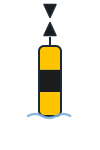
La cardinal OESTE tiene una marca de tope de dos conos opuestos por el vértice (forma de copa o reloj de arena) y su color es:
- Amarillo arriba y abajo, con una banda negra en medio Correct answer
- Negro arriba y abajo, con una banda amarilla en medio
- Negro arriba y amarillo abajo
- Amarillo arriba y negro abajo
Why?
West cardinal: two cones point to point (apexes together, 'wineglass' / hourglass). Colour yellow at top and bottom with a black band in the middle (black where the points meet). Safe water to the west.
Source IALA, Recomendación R1001 Ed. 2.0 (junio 2022), secc. 2.2.4 · Temario: RD 875/2014, anexo II, UT5 «Balizamiento» (BOE-A-2014-10344)
-
17
¿Qué indica una marca cardinal al navegante?
- Que las aguas más seguras están en el cuadrante que da nombre a la marca Correct answer
- El centro exacto de un canal
- Siempre el lado de babor de un canal
- Una zona de fondeo prohibido
Why?
A cardinal mark indicates that the safest (and usually deepest) navigable water lies in the quadrant of its name relative to the danger: north of a north cardinal, south of a south cardinal, and so on. Pass it on that side and always check the chart.
Source IALA, Recomendación R1001 Ed. 2.0 (junio 2022), secc. 2.2 · Temario: RD 875/2014, anexo II, UT5 «Balizamiento» (BOE-A-2014-10344)
-
18
Para rebasar con seguridad una marca cardinal norte, debemos pasar:
- Por el norte de la marca Correct answer
- Por el sur de la marca
- Indistintamente por cualquier lado
- Siempre por el este
Why?
A north cardinal indicates safe water to the north; therefore we pass it on its north side. The same applies to the others: south on the south, east on the east, west on the west.
Source IALA, Recomendación R1001 Ed. 2.0 (junio 2022), secc. 2.2 · Temario: RD 875/2014, anexo II, UT5 «Balizamiento» (BOE-A-2014-10344)
-
19
¿De qué color es siempre la luz de una marca cardinal?
- Blanca Correct answer
- Amarilla
- Roja
- Verde
Why?
Cardinal marks always show a white light, quick or very quick flashing. The light colour helps identify them: white = cardinal, isolated danger or safe water; yellow = special; red/green = lateral (Region A).
Source IALA, Recomendación R1001 Ed. 2.0 (junio 2022), secc. 2.2.4 · Temario: RD 875/2014, anexo II, UT5 «Balizamiento» (BOE-A-2014-10344)
-
20
La luz blanca de una marca cardinal NORTE es un centelleo:
- Continuo (rápido o muy rápido) Correct answer
- De grupos de tres
- De grupos de seis más un destello largo
- De grupos de nueve
Why?
North cardinal: continuous quick (Q) or very quick (VQ) flashing. Clock trick: north = top of the clock = continuous; east = 3 flashes; south = 6 (+ a long flash); west = 9.
Source IALA, Recomendación R1001 Ed. 2.0 (junio 2022), secc. 2.2.4 · Temario: RD 875/2014, anexo II, UT5 «Balizamiento» (BOE-A-2014-10344)
-
21
El ritmo de luz de una marca cardinal ESTE es un centelleo blanco en grupos de:
- Tres Correct answer
- Seis más un destello largo
- Nueve
- Continuo
Why?
East cardinal: groups of three flashes, VQ(3) every 5 s or Q(3) every 10 s. On the clock, east is at 3 o'clock → three flashes. The white light and flash count identify it at night.
Source IALA, Recomendación R1001 Ed. 2.0 (junio 2022), secc. 2.2.4 · Temario: RD 875/2014, anexo II, UT5 «Balizamiento» (BOE-A-2014-10344)
-
22
La marca cardinal SUR se identifica de noche por una luz blanca de grupos de:
- Seis centelleos seguidos de un destello largo Correct answer
- Tres centelleos
- Nueve centelleos
- Centelleo continuo
Why?
South cardinal: six flashes plus one long flash, VQ(6)+LFl every 10 s or Q(6)+LFl every 15 s. The final long flash confirms it is six (not nine) in the dark. On the clock, south = 6 o'clock.
Source IALA, Recomendación R1001 Ed. 2.0 (junio 2022), secc. 2.2.4 · Temario: RD 875/2014, anexo II, UT5 «Balizamiento» (BOE-A-2014-10344)
-
23
La marca cardinal OESTE muestra de noche una luz blanca de grupos de:
- Nueve centelleos Correct answer
- Tres centelleos
- Seis centelleos más uno largo
- Continuo
Why?
West cardinal: nine flashes, VQ(9) every 10 s or Q(9) every 15 s. On the clock, west is at 9 o'clock → nine flashes. Together with its wineglass topmark, there is no possible confusion.
Source IALA, Recomendación R1001 Ed. 2.0 (junio 2022), secc. 2.2.4 · Temario: RD 875/2014, anexo II, UT5 «Balizamiento» (BOE-A-2014-10344)
-
24
Una boya con franjas verticales azules y amarillas, coronada por una cruz amarilla vertical (en forma de +), señala:
- Un peligro nuevo no cartografiado, como un naufragio reciente Correct answer
- El lado de estribor de un canal
- Aguas navegables seguras
- Una marca cardinal este
Why?
This is the emergency wreck mark, used to indicate a new danger not yet charted, such as a recent wreck. It is recognised by its blue and yellow vertical stripes in equal number (between four and eight), by its topmark in the shape of an upright yellow cross — not a saltire, which belongs to special marks — and by its alternating blue and yellow light, one second of each colour. It may be reinforced with an AIS AtoN or a racon transmitting Morse code 'D'. If the competent authority considers the risk especially high, at least one of the marks is duplicated.
Source IALA, Recomendación R1001 Ed. 2.0 (junio 2022), secc. 2.6.2.1 · Temario: RD 875/2014, anexo II, UT5 «Balizamiento» (BOE-A-2014-10344)
That is all 24 questions on Buoyage (balizamiento). Answering them with instant feedback sticks far better than reading them.